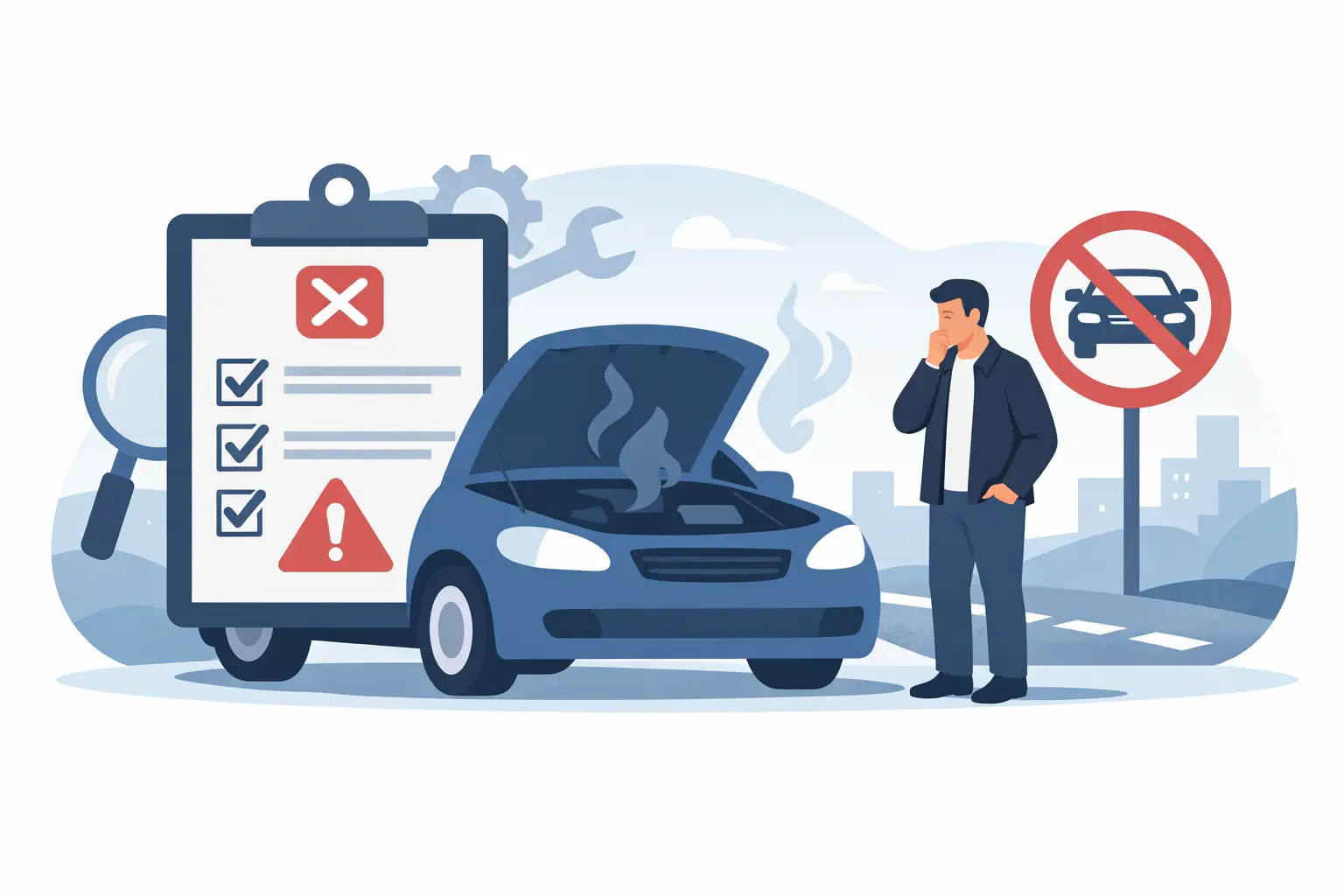
Few things are more frustrating than taking your car in for its MOT and hearing that it has failed. The question most drivers ask straight away is can you drive after MOT failure? The short answer is: sometimes, but not always. It depends on why the car failed, whether the previous MOT is still valid, and whether the vehicle has been classed as dangerous.
That uncertainty catches a lot of people out. Some motorists assume a failed MOT means the car cannot move at all. Others think they can carry on driving until the old certificate runs out. The truth sits somewhere in the middle, and getting it wrong can leave you with points, a fine, or a car that is simply not safe on the road.
Can you drive after MOT failure if the old MOT is still valid?
In some cases, yes. If your vehicle fails its MOT before the expiry date of the current MOT certificate, you may still be able to drive it until that certificate runs out. But there is a very important catch: the vehicle must still be roadworthy.
That means if the MOT test identifies a serious safety issue, you cannot rely on the old certificate as a free pass to keep using the car as normal. The law expects your vehicle to be safe every time it is on the road, whether the MOT is in date or not.
This is where the details on the MOT result matter. A fail is not just a fail. The tester may record defects as dangerous or major, and that changes what you should do next.
What the MOT failure categories mean
An MOT tester can record defects in a few different ways. Minor defects will not fail the test, but major and dangerous defects will.
Major defects
A major defect means the vehicle has failed the MOT and needs repair. In some situations, the car may still be driven away, but only if it remains roadworthy and legal to use. That is not something to guess at. If the issue affects braking, tyres, steering, suspension, lights, or visibility, the safest approach is not to drive it except where legally permitted for repair or retest.
Dangerous defects
A dangerous defect is more serious. If the vehicle is marked as dangerous, it should not be driven on the road until it has been repaired. This applies even if the current MOT has not yet expired.
Examples might include badly worn tyres below the legal limit, brakes that are not working properly, or steering faults that could make the vehicle unsafe to control. In plain terms, if the car has a dangerous defect, driving it puts you and other road users at risk.
Can you drive after MOT failure to a garage?
Usually, yes, but only in limited circumstances. If your MOT has expired or the vehicle has failed, you are generally allowed to drive it to a pre-booked MOT test or to a pre-booked repair appointment. That said, this does not override roadworthiness rules.
So if the car is dangerous to drive, you should not drive it to the garage yourself. It is better to arrange recovery. It may feel like an extra cost at the time, but it is far cheaper than the consequences of an accident or prosecution.
If the car has failed on something less immediately risky, such as emissions or a registration plate issue, driving it to a booked repair may be lawful. But if there is any doubt, ask the garage directly before setting off. A good local garage will give you a straight answer.
What happens if your MOT has already expired?
This is where drivers need to be especially careful. If your MOT has expired and the car fails its test, you cannot drive it normally on public roads. The main exception is travelling to a pre-booked MOT appointment or to a garage for repairs connected to the test.
That does not mean you can use the car for work, school runs, shopping, or everyday journeys while you sort it out. Once the MOT has expired, routine driving is off the table until the vehicle passes.
Even then, roadworthiness still applies. A vehicle with dangerous defects should not be driven, full stop.
Why a valid MOT is not the whole story
Many people think the MOT is the legal line between road legal and illegal. It is part of the picture, but not the whole of it.
An MOT certificate shows that the vehicle met the minimum test standards on the day it was inspected. It does not guarantee the car will stay roadworthy afterwards. If your tyres wear out a week later, or a brake fault develops, the existence of a valid certificate does not protect you.
That is why police and DVSA can still take action against drivers whose cars are unsafe, even if the MOT appears current. A failed MOT that highlights dangerous defects is a clear warning sign, and ignoring it can cause real trouble.
What are the risks of driving after an MOT failure?
The biggest risk is safety. Faulty brakes, worn tyres, cracked suspension components, blown bulbs, or steering issues can all turn a routine journey into a serious incident.
There are legal and financial risks as well. You could face a fine for driving a vehicle in a dangerous condition. In more serious cases, penalty points may apply. Your insurance could also become complicated if you have an accident in a car that was known to be unsafe.
This is one of those situations where trying to save time can cost much more later. If the vehicle has failed, especially with major or dangerous defects, the sensible move is to understand the fault properly and deal with it before carrying on.
How to know whether you should drive the car or not
Start with the MOT result sheet. Look at the exact wording of the defects. If anything is marked dangerous, do not drive the vehicle on the road.
If the defects are major, check whether your current MOT is still valid and then ask a professional whether the car is roadworthy enough to move. Do not assume that because it starts, it is safe. Plenty of unsafe cars still drive.
If your MOT has expired, only drive to a pre-booked MOT or repair appointment, and only if the vehicle is safe enough to make that trip. If there is a concern about brakes, steering, tyres or anything that affects control of the vehicle, recovery is the better option.
Common MOT failures that may stop you driving
Some failures are more serious than others. A number plate light out or a minor emissions issue is very different from a split tyre sidewall or a brake imbalance.
Drivers should be particularly cautious with failures involving tyres, brakes, steering, suspension, seatbelts, windscreens that seriously affect the driver’s view, and lights needed for safe visibility. These are the areas most likely to make a car unroadworthy straight away.
For everyday motorists, the practical rule is simple: if the fault affects stopping, steering, seeing, or being seen, do not take chances.
What to do straight after an MOT failure
First, do not panic. A failed MOT is common, especially on older vehicles, and many faults are straightforward to put right.
Read the failure sheet carefully and ask the garage to explain the issues in plain English. You should know which items are dangerous, which are major, how urgent they are, and what the likely repair cost will be. A trustworthy garage will be clear about what needs doing now and what can wait.
If the car is safe and legal to move, book the repairs promptly. If it is not, arrange recovery or leave it with the garage. This is often the simplest route, especially if the test and repairs can be handled in one place.
For local drivers in and around High Wycombe, this is where using a dependable independent garage can make life easier. You want clear advice, honest pricing, and repairs that are explained properly, not a hard sell.
A quick word on retests
Once repairs are completed, the vehicle will need a retest. In some cases, if the repairs are done quickly and at the same test centre, a partial retest may apply. The garage can tell you what the process looks like and whether any extra fee is involved.
It is worth getting this sorted as soon as possible. The longer a failed vehicle sits unresolved, the more awkward it becomes if you need the car for work, school, or family commitments.
The practical answer most drivers need
So, can you drive after MOT failure? Sometimes, yes – but only if the vehicle is still roadworthy, the defect is not dangerous, and you are staying within the rules around valid MOT cover and pre-booked appointments.
If that sounds a bit less clear-cut than you hoped, that is because the law is based on the vehicle’s actual condition, not just the pass or fail stamp. When in doubt, ask the garage, check the defect category, and err on the side of caution. A short delay is always better than risking your safety on the road.