
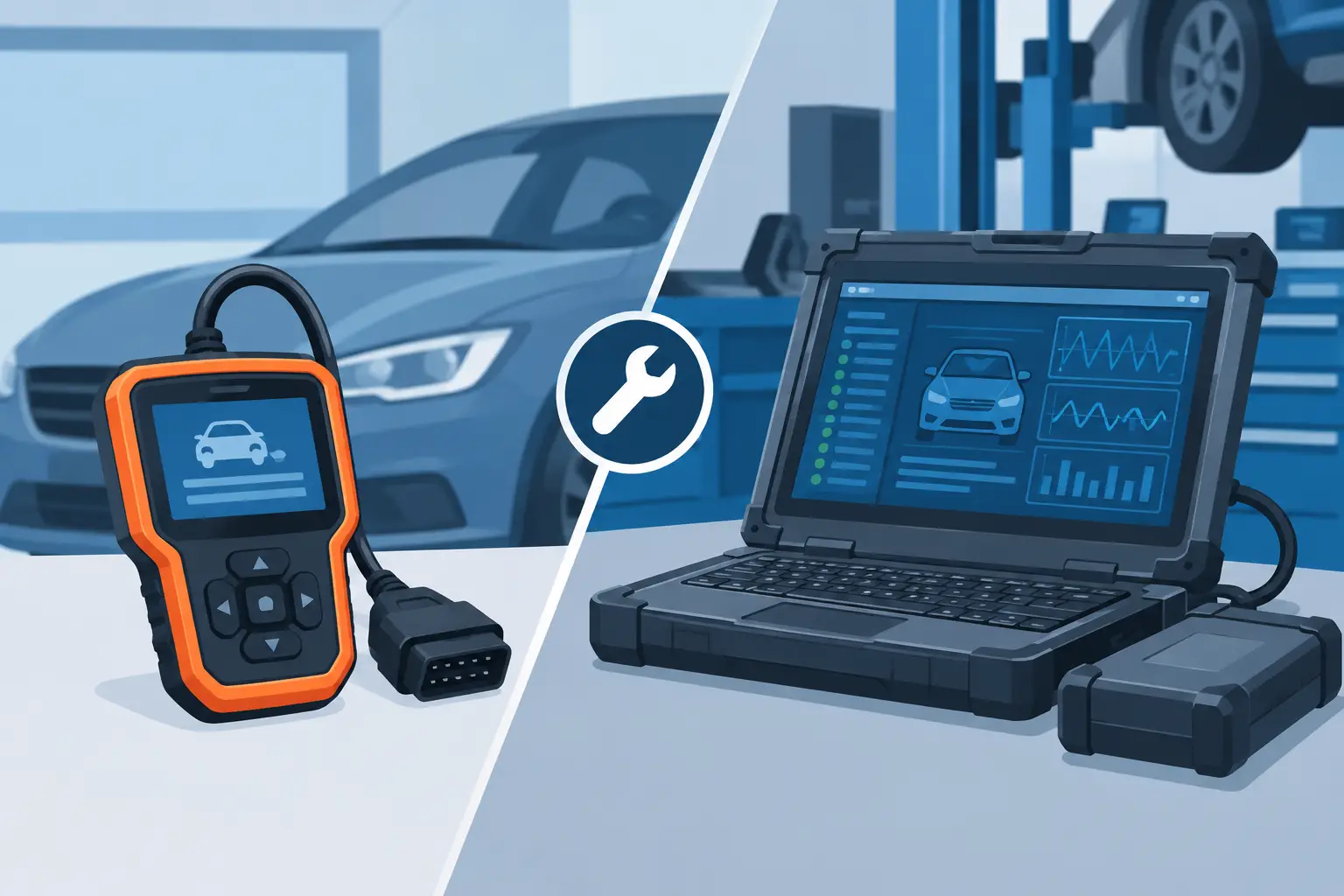
A warning light appears on the dashboard during the school run or your commute into High Wycombe. A small OBD scanner promises a quick answer from the driveway, while a garage diagnostic check can feel like another expense. The reality of OBD scanner versus professional diagnostics is not that one is always better than the other. They do different jobs, and knowing the difference can save you time, money and avoidable worry.
An OBD scanner is useful for finding out where to start. Professional diagnostics are needed to establish what has actually failed, why it failed and whether the car is safe to drive. That distinction matters because a fault code is not the same thing as a repair instruction.
What an OBD scanner can tell you
Most cars built for the UK market since 2001 for petrol engines, and 2004 for diesel engines, have an On-Board Diagnostics port. This is usually located beneath the dashboard. A basic scanner or phone app can plug into this port and read stored fault codes from the vehicle’s control units.
These codes are helpful. For example, a scanner may report a misfire on a particular cylinder, a problem with an oxygen sensor, low boost pressure or an issue linked to the diesel particulate filter. It may also show whether the engine management light was caused by an intermittent fault or one that is currently active.
For a driver, that information can be reassuring. It can help you decide whether to book the car in promptly, especially if the light has appeared without an obvious change in how the car drives. It can also be useful when you want to record a code before the warning light disappears.
A basic scanner is particularly handy for simple checks, such as seeing why the engine management light is on after a loose fuel cap, or confirming whether a known minor fault has returned. Some more advanced consumer scanners can display live readings, including coolant temperature, engine speed and battery voltage.
But there is a limit. The scanner reads information the car has detected. It does not inspect the condition of a part, test a wiring circuit properly or prove which component needs replacing.
Why a fault code is not a diagnosis
This is the part that often catches drivers out. If a scanner gives a code for an oxygen sensor, it does not automatically mean the sensor itself is faulty. The reading may be affected by an air leak, damaged wiring, an exhaust leak, poor fuel pressure or another engine fault further up the chain.
Replacing the part named in a code without further testing is sometimes successful, but it is also how unnecessary bills build up. The same applies to codes relating to EGR valves, DPF systems, glow plugs, injectors and turbocharger performance. Modern vehicles are made up of connected systems, so one issue can trigger warnings in another.
A code can be thought of as the car raising its hand and saying something is outside its expected range. It does not always explain the root cause. A professional technician uses that clue alongside the vehicle’s symptoms, service history, visual checks, live data and targeted tests.
There is another complication: not all faults generate a useful code. A worn clutch, noisy wheel bearing, weak battery connection, coolant leak or brake problem may not show up on a basic code reader at all. If your car feels different, makes an unusual noise, pulls to one side or has a warning message, it still deserves proper attention even when the scanner says no codes are stored.
OBD scanner versus professional diagnostics: the practical difference
Professional diagnostics combine suitable equipment with experience and methodical testing. Garage-level equipment can communicate with more vehicle systems than many low-cost scanners, including ABS, airbag, steering, body control, transmission and manufacturer-specific modules. It can also carry out guided tests and access information that a generic reader may not show.
The equipment is only part of the picture. An experienced technician will ask what happened before the warning appeared. Did the engine run roughly only when cold? Did the fault start after the battery went flat? Is the warning light permanent, flashing or intermittent? These details help narrow down the investigation.
They may then inspect connectors and hoses, test the battery and charging system, check fluid levels, look for leaks, examine live sensor readings, test electrical circuits and road test the vehicle where appropriate. If a part is identified as faulty, the garage can explain why it needs replacing and what the repair involves.
This approach takes longer than plugging in a reader, but it reduces guesswork. It is especially valuable when the problem keeps returning, the vehicle has multiple warning lights, or previous parts have been replaced without curing the issue.
When using your own scanner makes sense
There is nothing wrong with owning an OBD scanner if you see it as a useful first check rather than a substitute for repairs. It can be a sensible tool for drivers who like to keep an eye on their car and want a little more context before booking in.
If a warning light comes on but the car is driving normally, note the code, take a photograph of it and arrange an inspection. Do not clear the code immediately. Clearing it may turn off the dashboard light temporarily, but it also removes useful evidence that a technician could use to trace the fault. The light may return once the car completes its monitoring checks.
A scanner can also help after a repair, provided the underlying issue has been correctly fixed. However, it should not be used to hide a warning light before an MOT. The fault is still there if the cause has not been addressed, and warning lights relating to safety or emissions can lead to an MOT failure.
When to book professional diagnostics straight away
Some warning lights and symptoms should not be treated as a wait-and-see situation. A flashing engine management light can indicate an active misfire that may damage the catalytic converter. A red oil-pressure warning, overheating warning, brake warning or battery warning needs prompt action, and in some cases you should stop driving as soon as it is safe to do so.
Book a professional check without delay if the car is losing power, struggling to start, stalling, smoking, overheating or using noticeably more fuel. The same applies if several warning lights appear together. Electrical faults, low battery voltage and communication issues can create a confusing mix of codes that need careful testing rather than assumptions.
Diesel drivers should also take DPF warnings seriously. A short journey may occasionally allow a regeneration to complete if the handbook advises it and the car is otherwise running correctly. But repeated warnings, reduced power or a warning accompanied by other faults require investigation. Forcing a regeneration when another fault is present can make matters worse.
How to get the most from a diagnostic appointment
You do not need technical knowledge to help the process. Tell the garage exactly what you have noticed: when the warning first appeared, whether it comes and goes, how the car feels, and whether any work was carried out recently. Mention if the battery has gone flat or the vehicle has been jump-started, as this can be relevant.
If you have scanned the car, bring the codes with you, but do not feel you need to tell the technician what part to fit. A good garage will treat the code as a starting point and explain their findings in plain English before any repair work goes ahead.
At Kingshill Autos, the aim is to identify the real cause of a fault and give you a clear, honest explanation of the options. Sometimes the answer is a straightforward repair. Other times, further testing is needed before anyone can fairly promise a fix. Being clear about that protects you from paying for parts your car did not need.
The sensible choice is often both
An OBD scanner can give you useful information quickly. Professional diagnostics provide the testing and judgement needed to turn that information into a reliable repair. For a minor, one-off warning, a scanner may help you understand the urgency. For persistent faults, poor running, safety concerns or anything that affects your confidence in the car, a proper diagnostic inspection is the wiser route.
Keep a note of warning lights and changes in how your vehicle behaves, then ask for the findings to be explained clearly. A dependable repair starts with an accurate diagnosis, not with a guess based on a code.


