
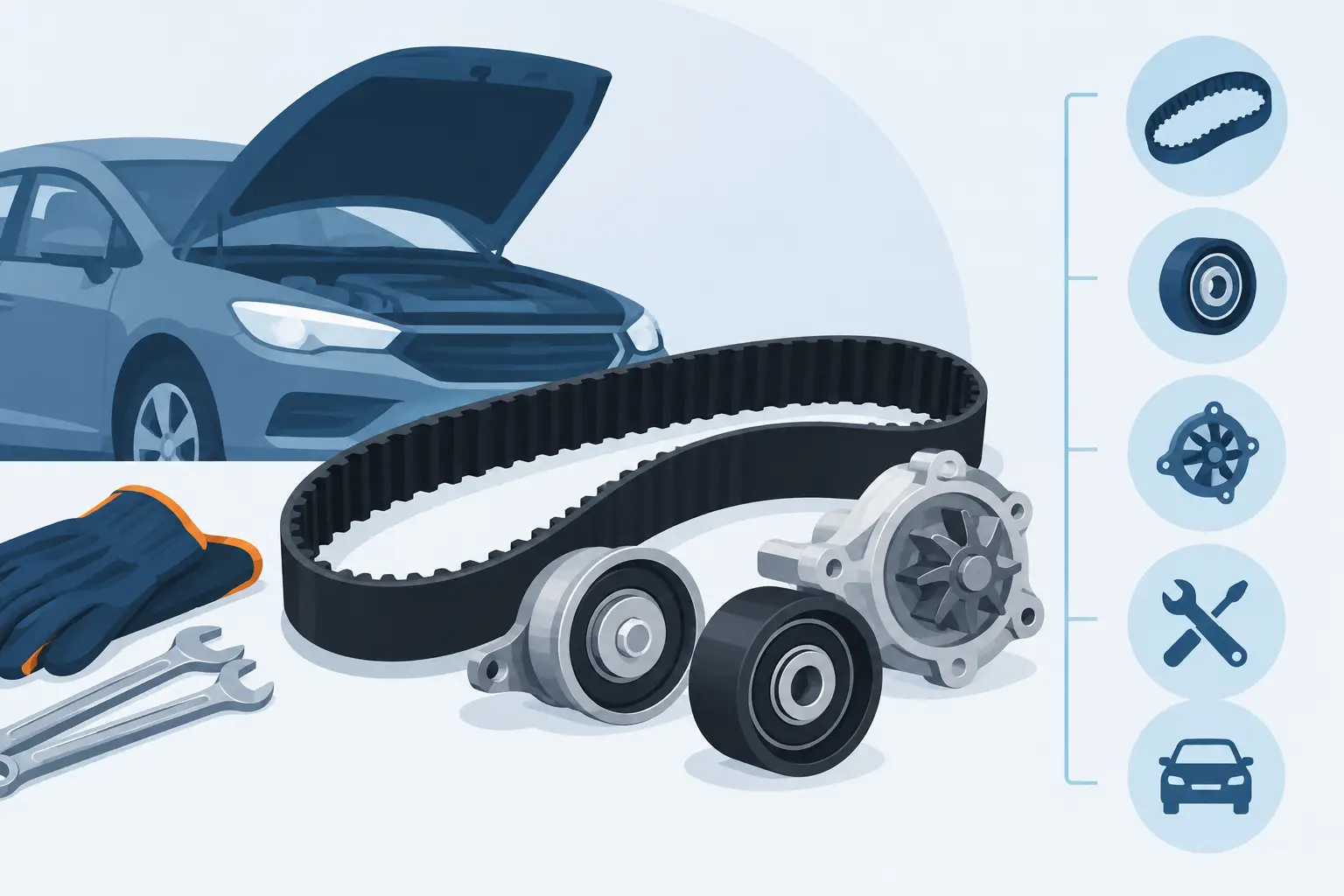
A timing belt is a relatively small part with a very big job. If it fails while you are driving, the damage can be serious and expensive. That is why timing belt replacement costs are best viewed as planned maintenance, rather than a repair to put off until something goes wrong.
For drivers in High Wycombe and the surrounding area, the sensible question is not simply how much a belt costs. It is what is included in the work, whether your vehicle is due, and whether the quote covers the parts that should be renewed at the same time. A clear answer to those questions helps you compare garage quotes fairly and avoid unwelcome surprises.
What do timing belt replacement costs usually look like?
For many cars, a timing belt replacement in the UK commonly falls somewhere between £350 and £900. Some smaller, straightforward engines can cost less, while larger vehicles, premium models and engines with difficult access can run beyond £1,000.
That range is wide because the belt itself is not usually the expensive part. The cost is largely shaped by the time needed to reach it, remove related components, set the engine timing accurately and rebuild everything correctly. On some cars the job may take a few hours; on others it can take most of a working day.
A cheap quote is not automatically a bad one, and a higher quote is not automatically better. What matters is whether it explains the labour, the quality of parts being used and exactly what is included. An honest garage should be happy to talk you through this in plain English.
Typical guide prices
As a broad guide, many petrol hatchbacks and family cars sit in the middle of the usual range. Diesels can be more expensive because access may be tighter and the work can be more involved. Certain engines require specialist procedures or additional parts, which increases the labour time.
If your car has a wet belt, the likely cost may be higher. A wet belt runs inside the engine and in oil, rather than behind a dry outer cover. Replacing it often involves more dismantling, careful cleaning and the correct oil specification afterwards. Depending on the vehicle, wet belt replacement can commonly range from around £700 to £1,500 or more.
The best way to get a meaningful figure is to provide your registration number. This allows a garage to identify the correct engine, service schedule and parts required, rather than giving a guess based only on the car’s make and model.
What should be included in the quote?
A timing belt is normally replaced as part of a kit. This should include the belt itself and the tensioner and guide rollers that keep it running correctly. Reusing worn tensioners or rollers simply to reduce the initial price can be false economy.
It is also common to replace the water pump during the same job, where the pump is driven by the timing belt or access is already available. A water pump is much less expensive to replace while the belt is off than it is to revisit later. If the pump fails after a belt-only job, much of the same labour has to be paid for again.
A proper quotation should make clear whether it includes the timing belt kit, water pump where appropriate, coolant, seals or bolts required by the manufacturer, labour and VAT. It may also include a fresh auxiliary belt if that belt has to be removed and is showing age or wear. There is no one-size-fits-all package, but there should be no mystery about what you are paying for.
Why does the price vary so much between cars?
Every engine is packaged differently. On one vehicle, a technician may be able to access the belt by removing a wheel and a few covers. On another, engine mounts, intake components and other parts may need to come off first. There is also the question of engine design: some engines have one camshaft, while others use more complex arrangements that need particularly precise timing.
Parts quality also affects the bill. A reputable garage will use parts that meet the correct standard for the vehicle, rather than fitting the cheapest available option. Timing components are not the place to cut corners, because a failure can lead to bent valves, damaged pistons or, in severe cases, an engine that needs rebuilding or replacing.
Local labour rates play a part too. Independent garages can often offer a more competitive price than a main dealer while still using the right equipment, technical information and quality parts. The key is not to choose on price alone. Choose a garage that explains the work and stands behind it.
When should a timing belt be replaced?
There is no universal mileage or age for timing belt replacement. Manufacturers set different intervals, often based on mileage, age or whichever comes first. Some cars may be due around 60,000 miles or five years, while others have longer intervals. Your vehicle handbook or service schedule is the starting point, but a garage can check the manufacturer guidance for your exact registration.
Age matters just as much as mileage. A low-mileage car that mainly does short local journeys can still be due a belt replacement because rubber deteriorates over time. This is particularly relevant for second cars, vehicles used occasionally, and cars with an incomplete service history.
If you have just bought a used car and cannot prove when the belt was last changed, it is worth investigating straight away. A previous owner’s verbal assurance is not the same as a dated invoice showing the mileage, parts fitted and garage details. In many cases, arranging the replacement gives useful peace of mind.
Can you tell when a timing belt is wearing out?
Usually, no. Unlike brakes, a timing belt often gives little or no reliable warning before it breaks. Squealing, poor running or visible cracking may point to an issue in some cases, but waiting for a symptom is not a safe maintenance plan.
The sensible approach is to follow the replacement interval and deal with oil leaks promptly. Oil contamination can damage a conventional dry belt, while a wet belt system relies on the correct manufacturer-approved engine oil. Using the wrong oil or extending oil-change intervals can contribute to premature wet belt deterioration on affected engines.
Wet belt replacement needs particular care
Wet belts are not inherently something to panic about, but they do need the right maintenance. They operate in engine oil, so the oil type, service interval and condition all matter. If belt material begins to break down, debris can circulate in the oil and may affect the oil pickup or lubrication system.
A proper wet belt replacement may therefore involve more than fitting a new belt. The technician may need to inspect and clean relevant areas, replace associated components and refill the engine with the specified oil. That is one reason quotes for wet belt work can look higher than those for a conventional timing belt.
Do not assume that every car with a belt has a wet belt, or that every engine from the same manufacturer uses the same setup. The exact engine code matters. A garage should confirm this before recommending work.
How to compare timing belt quotes fairly
When you are comparing prices, ask whether the quote includes the full belt kit, the water pump where applicable, coolant, VAT and all labour. It is also reasonable to ask which brand of parts will be fitted and whether the work is covered by a parts and labour warranty.
Be cautious of a very low headline price that does not mention the tensioner, pump or VAT. Those additions can change the final bill considerably. Equally, a garage may identify extra work once components are removed, such as a leaking seal or worn auxiliary belt. That does not always mean the original quote was misleading. What matters is that you are contacted, given a clear explanation and asked for approval before additional work is carried out.
At Kingshill Autos, we believe vehicle repairs should be straightforward: explain what is due, quote clearly and carry out only the work your car genuinely needs. If you are unsure about your belt’s history or replacement interval, checking now is far easier than dealing with the consequences of a failure later.
A timing belt replacement is one of those jobs that is easy to forget because you cannot see it every day. Put the due date in your diary, keep the invoice with your service records and ask for clear advice when the time comes. Your engine, and your future self, will thank you.


